Project Excalibur was an American Cold War–era research program to develop nuclear-device-powered, space-based X-ray lasers as a ballistic missile defense. X-ray lasers were conceived in the 1970s by George Chapline Jr. (pictured with George Maenchen) and further developed by Peter L. Hagelstein, both working at Lawrence Livermore National Laboratory under Edward Teller. After a promising test, Teller discussed the proposal in 1981 with US president Ronald Reagan, who in 1983 incorporated it in his Strategic Defense Initiative. Further underground nuclear tests suggested progress was being made. Reagan refused to abandon the technology at the 1986 Reykjavík Summit arms-control talks, even after a critical test demonstrated it was not working as expected. Researchers at Livermore and Los Alamos began to raise concerns about test results, and the infighting became public. In 1988 the program budget was cut dramatically, after additional problems were revealed.
Showing posts with label article of the day. Show all posts
Friday, November 13, 2020
Wikipedia article of the day for November 14, 2020
Project Excalibur was an American Cold War–era research program to develop nuclear-device-powered, space-based X-ray lasers as a ballistic missile defense. X-ray lasers were conceived in the 1970s by George Chapline Jr. (pictured with George Maenchen) and further developed by Peter L. Hagelstein, both working at Lawrence Livermore National Laboratory under Edward Teller. After a promising test, Teller discussed the proposal in 1981 with US president Ronald Reagan, who in 1983 incorporated it in his Strategic Defense Initiative. Further underground nuclear tests suggested progress was being made. Reagan refused to abandon the technology at the 1986 Reykjavík Summit arms-control talks, even after a critical test demonstrated it was not working as expected. Researchers at Livermore and Los Alamos began to raise concerns about test results, and the infighting became public. In 1988 the program budget was cut dramatically, after additional problems were revealed.
Thursday, November 12, 2020
Wikipedia article of the day for November 13, 2020
Edward Thomas Daniell was an English artist known for etchings and Middle Eastern landscape paintings. Taught by John Crome and Joseph Stannard, he is associated with the Norwich School of painters, who were mainly inspired by the Norfolk countryside. After graduating in classics at Balliol College, Oxford, in 1828, he was ordained as a curate in 1832 and appointed to a curacy in London in 1834. He became a patron of the arts, and a friend of the artist John Linnell. In 1840, after resigning his curacy and leaving for the Middle East, he encountered the archaeological expedition of Charles Fellows in Lycia, and joined as their illustrator. He contracted malaria and died from a second attack of the disease. He normally used a small number of colours for his watercolour paintings; his distinctive style was influenced in part by Crome, J. M. W. Turner and John Sell Cotman. As an etcher he anticipated the modern revival of etching that began in the 1850s.
Wednesday, November 11, 2020
Wikipedia article of the day for November 12, 2020
The St. Croix macaw (Ara autocthones) is an extinct species of macaw whose remains have been found on the Caribbean islands of St. Croix and Puerto Rico. It was a medium-sized macaw of unknown coloration, slightly larger than the extinct Cuban macaw. It was described in 1937 based on a tibiotarsus leg bone (pictured) unearthed from a kitchen midden at a pre-Columbian site on St. Croix. A second specimen consisting of various bones from a similar site on Puerto Rico was described in 2008, and a coracoid from Montserrat may belong to this or another extinct species of macaw. The St. Croix macaw is one of 13 extinct macaw species that have been proposed to have lived on the Caribbean islands. Macaws were frequently transported for long distances by humans in both prehistoric and historic times, so it is impossible to know whether species only known from bones or written accounts were native or imported species.
Sunday, November 8, 2020
Wikipedia article of the day for November 9, 2020
Yashima was a Fuji-class pre-dreadnought battleship built for the Imperial Japanese Navy in the 1890s. Yashima (a classical name for Japan) was designed and built in the United Kingdom, as Japan lacked the necessary industrial capacity. Her main battery consisted of four 12-inch (305 mm) guns. Commanded by Captain Hajime Sakamoto at the start of the Russo-Japanese War, the ship participated in the Battle of Port Arthur on 9 February 1904 when Vice-Admiral Tōgō Heihachirō led his battleships and cruisers in an attack on Russia's Pacific Squadron. Yashima was involved in war operations until May, when she struck two mines off Port Arthur. She did not sink immediately, but capsized while under tow later that day. The Japanese were able to keep her loss a secret from the Russians for over a year; as part of the deception, surviving crewmen who were guarding Port Arthur addressed their letters as if they were still aboard the battleship.
Saturday, November 7, 2020
Wikipedia article of the day for November 8, 2020
The king brown snake (Pseudechis australis) is a species of highly venomous snake of the family Elapidae, native to northern, western, and Central Australia. Despite its common name, it is a member of the genus Pseudechis (black snakes) and only distantly related to true brown snakes. First described by the English zoologist John Edward Gray in 1842, it is a robust snake up to 3.3 m (11 ft) long. It is variable in appearance, with individuals from northern Australia having tan upperparts, while those from southern Australia are dark brown to blackish. The dorsal scales are two-toned, sometimes giving the snake a patterned appearance. Its underside is cream or white, often with orange splotches. The snake is considered to be a least-concern species. Its venomous bites often produce extensive pain and swelling, and deaths have been recorded, most recently in 1969. Its victims are treated with black-snake (not brown-snake) antivenom.
Monday, November 2, 2020
Wikipedia article of the day for November 3, 2020
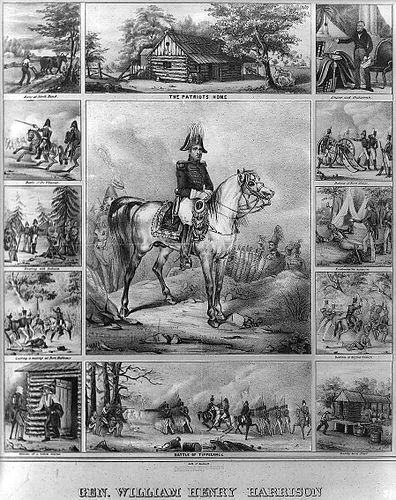
William Henry Harrison's 1840 presidential campaign elevated Harrison, who had served as a general and in the U.S. Congress, to the presidency after at least four years of seeking the office. In the election, Harrison defeated the incumbent Democrat, Martin Van Buren, in a campaign that broke new ground in American politics. Among other firsts, Harrison's victory was the first time the Whig Party won the presidency. Harrison gained the nomination over Henry Clay and Winfield Scott. Many of his rallies took on a carnival atmosphere, growing to unprecedented size. He made speeches to some of them, breaking the custom that presidential hopefuls not campaign. Harrison's death in April 1841 marked the first time an American president failed to complete his term; he was succeeded by Vice President John Tyler. The unofficial campaign motto, "Tippecanoe and Tyler Too", has been called the most famous presidential campaign slogan in American history.
Sunday, November 1, 2020
Wikipedia article of the day for November 2, 2020
Dali is a hunting goddess from the mythology of the Georgian people. The patron of hoofed wild mountain animals, she was said to reward hunters who obeyed her taboos and to punish violators. She was usually described as a beautiful nude woman with golden hair and glowing skin, although she sometimes took on the form of her favored animals. Stories depict her taking human lovers and jealously killing them, and later clashing with her rival Saint George. After the rise of Christianity in Georgia, the stories told about Dali changed; Saint George was presented as having the power to overrule her, and she began to be conflated with a malicious nature spirit called the ali. As a patron of the hunt, she has been compared with Artemis of Greek mythology, a hag in Scottish mythology called the glaistig, and a maiden from folklore who tames a unicorn. Her associations with gold, seduction, and the morning star have led scholars to draw connections with goddesses such as Aphrodite and Ishtar.
Saturday, October 31, 2020
Wikipedia article of the day for November 1, 2020
Typhoon Gay was a small but powerful tropical cyclone that caused more than 800 fatalities in and around the Gulf of Thailand in November 1989. The worst typhoon to affect the Malay Peninsula in 35 years, Gay rapidly intensified from a monsoon trough, and on 3 November became the first typhoon since 1891 to make landfall in Thailand. It re-emerged into the Bay of Bengal and reorganized as it approached southeastern India. The typhoon moved ashore near Kavali, Andhra Pradesh, and dissipated over Maharashtra early on 10 November. The typhoon's rapid development took seafarers by surprise, leading to 275 offshore fatalities. Across the Malay Peninsula, 588 people died from various storm-related incidents and several towns were destroyed. Losses throughout Thailand totaled ฿11 billion (US$497 million). In India, Gay damaged or destroyed about 20,000 homes in Andhra Pradesh. It left 100,000 people homeless, caused 69 deaths, and was responsible for ₹410 million (US$25.3 million) in damage.
Friday, October 30, 2020
Wikipedia article of the day for October 31, 2020
Bill Kibby (15 April 1903 – 31 October 1942) was a British-born Australian recipient of the Victoria Cross, the highest award for gallantry in the face of the enemy that could be awarded to a member of the Australian armed forces during World War II. In 1940, Kibby enlisted in the all-volunteer Second Australian Imperial Force and joined the 2/48th Infantry Battalion. He was injured before the Siege of Tobruk, but was with the battalion during the First Battle of El Alamein in July 1942. In October, the battalion was committed to the Second Battle of El Alamein. Between 23 and 31 October, Kibby went forward alone and silenced an enemy machine gun post, mended a telephone line under heavy fire, and pressed forward under withering machine gun fire to help his company capture its objective. After this final action ultimately cost him his life, the Victoria Cross was awarded for his inspirational leadership.
Thursday, October 29, 2020
Wikipedia article of the day for October 30, 2020
The European storm petrel (Hydrobates pelagicus) is a small, square-tailed seabird with a fluttering flight. It is black except for a white rump and a white band under its wings. Most birds breed on islands off western Europe, with a separate subspecies occurring in the Mediterranean. The storm petrel lays a single white egg in a burrow. The adults share incubation and feeding the chick. This bird is oceanic outside the breeding season, wintering off the western coasts of Africa. It feeds on small fish, and can find oily edible items by smell. The chick is fed with an oily liquid regurgitated by the adults. Silent at sea, the storm petrel has a chattering call given during courtship, and the male has a purring song. The storm petrel cannot survive where rats or cats have been introduced, and it is killed by large birds such as gulls. It is classified by the IUCN as being of least concern. Folklore claiming that the bird can foretell or cause bad weather has led to its use as a symbol by some revolutionary groups.
Wednesday, October 28, 2020
Wikipedia article of the day for October 29, 2020
Portrait of Mariana of Austria is a 1652 or 1653 oil-on-canvas painting by Diego Velázquez, the leading artist of the Spanish Golden Age. Its subject, Dona Mariana (known as Maria Anna), was the daughter of Emperor Ferdinand III and Maria Anna of Spain, and was nineteen years old when the painting was completed. Although vivacious and fun-loving in life, she is given an unhappy expression in Velázquez's portrait. The painting is bathed in harmonious shades of black and red, and her face is heavily made up. Her right hand rests on the back of a chair, and she holds a lace handkerchief in her left hand. Her bodice is decorated with jewellery, including a gold necklace, bracelets and a large gold brooch. The clock placed on the scarlet drapery behind her indicates her status. Three full-length versions of the portrait survive, as well as a number of half-length variants. The version in the Museo del Prado (detail pictured) is known to be the original and is dated on the basis of a matching description of a canvas sent to Ferdinand in Vienna in December 1651.
Monday, October 26, 2020
Wikipedia article of the day for October 27, 2020
The first game in the history of the Wales national football team was in 1876, making Wales the third-oldest side in international association football, after Scotland and England. Wales played annual games against Scotland, England, and later Ireland, which became the British Home Championship. Wales won their first championship in the 1906–07 tournament, three more titles during the 1920s, and four in the six years prior to World War II. After the war, Wales played teams from other European nations and began competing in the FIFA World Cup, but failed to qualify in 1950 and 1954. Wales qualified in 1958, being defeated by Brazil in the quarter-final. The side declined in the 1960s, failing to qualify for a World Cup or the European Nations' Cup. Wales won their last British Championship during the 1969–70 season, before the competition was discontinued. Manager Mike Smith led the side to the quarter-finals of the 1976 European Championships in their centenary year, when they were defeated by Yugoslavia.
Sunday, October 25, 2020
Wikipedia article of the day for October 26, 2020
William Anderson (1840 – October 26, 1864), known as "Bloody Bill" Anderson, was one of the deadliest pro-Confederate guerrilla leaders of the American Civil War, leading a band of volunteer partisans who targeted Union loyalists and federal soldiers in Missouri and Kansas. After his father was killed by a Union loyalist judge during the war, Anderson killed the judge and fled to Missouri where he robbed travelers and killed several Union soldiers. In 1863 he took a leading role in the Lawrence massacre and later participated in the Battle of Baxter Springs. By 1864 Anderson was the leader of a group of raiders in Missouri. In September 1864, he led a raid on the town of Centralia, where his men captured a passenger train; they executed 24 unarmed Union soldiers in the Centralia Massacre. Later that day they killed more than a hundred Union militiamen in an ambush. Anderson died in battle a month later.
Saturday, October 24, 2020
Wikipedia article of the day for October 25, 2020
Soultaker is an American fantasy horror film written by Vivian Schilling and directed by Michael Rissi, released on October 26, 1990. It stars Joe Estevez in the title role, alongside Schilling, Gregg Thomsen, Chuck Williams, Robert Z'Dar, and David "Shark" Fralick. The film follows a group of young adults who try to flee from the Soultaker when their souls are ejected from their bodies after a car accident. Inspired by discussions with Action International Pictures producer Eric Parkinson, the script was based on a real-life car accident Schilling was involved in. The film was shot in five weeks on a $250,000 budget. Originally planned for a direct-to-video release, it saw limited theatrical screenings, with eight prints distributed in United States. Since its release, the film has received negative reviews, but won the Saturn Award for "Best Genre Video Release" in 1992. A sequel was planned but never made, and Schilling turned its premise into a novel titled Quietus, published in 2002. Soultaker was featured in the tenth-season premiere episode of the comedy television series Mystery Science Theater 3000 in 1999.
Friday, October 23, 2020
Wikipedia article of the day for October 24, 2020
Super-Science Fiction was an American digest science fiction magazine published from 1956 to 1959, edited by W. W. Scott and published by Feature Publications. Robert Silverberg and Harlan Ellison were already selling crime stories to Scott for his other magazines, Trapped and Guilty, and started bringing him scores of science fiction stories as well. Many of the magazine's stories were sent in by literary agents, and generally comprised material rejected by other magazines first, though Scott did obtain two stories from Isaac Asimov. After a couple of years Feature switched the focus to monster stories, hoping to cash in on the trend that was making Famous Monsters of Filmland a success at that time, and four more issues appeared before Super-Science Fiction was discontinued in 1959. The magazine is not highly regarded by critics, though Silverberg considers the material he wrote for Scott to have helped him learn his trade as a writer.
Wednesday, October 21, 2020
Wikipedia article of the day for October 22, 2020
The Wikipedia article of the day for October 22, 2020 is Battle of Goodenough Island.The Battle of Goodenough Island was a battle of the Pacific campaign of World War II fought between 22 and 27 October 1942. Japanese forces had been stranded on Goodenough Island, Papua, during the Battle of Milne Bay. Aircraft and ships headed from Milne Bay to Buna and vice versa had to pass close to Goodenough Island, and a presence on the island could provide warning of enemy operations. The island also had flat areas suitable for the construction of emergency airstrips. The Allies attacked the island prior to the Buna campaign. A force consisting of the Australian 2/12th Battalion and attached units landed on the southern tip at Mud Bay and Taleba Bay on 22 October and, following a short but heavy fight, during which the Australians found it difficult to advance, the Japanese forces withdrew to Fergusson Island on 27 October. The island was developed by the Allies after the battle and became a major base for operations later in the war.
Tuesday, October 20, 2020
Wikipedia article of the day for October 21, 2020
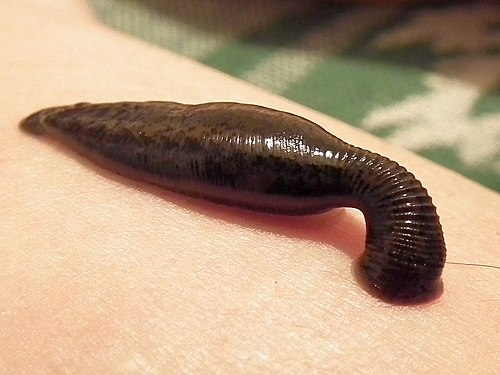
Leeches are segmented parasitic or predatory worms of the subclass Hirudinea in the phylum Annelida. Like earthworms, they have soft, muscular, segmented bodies that can lengthen and contract, but the coelom, the body cavity that can be spacious in other annelids, is reduced to small channels, and they typically have suckers at both ends. Most leeches live in freshwater habitats, though some species can be found in terrestrial and marine environments. A minority of leech species prey on small invertebrates, but most are hematophagous, attaching themselves to a host with a sucker and feeding on blood. They were used in medicine from ancient times until the 19th century to draw blood from patients. In modern times, leeches have been used in microsurgery and in the treatment of extremity vein diseases and joint diseases such as epicondylitis and osteoarthritis. Hirudin, an anticoagulant drug they secrete, has been used to treat blood-clotting disorders.
Monday, October 19, 2020
Wikipedia article of the day for October 20, 2020
Stucky is a term used to denote the pairing of Steve Rogers (Captain America) and James Buchanan "Bucky" Barnes (the Winter Soldier), fictional characters appearing in comic books and related media produced by Marvel Comics. It is a manifestation of shipping, a phenomenon in fandom wherein individuals create fan works that depict a romantic or sexual relationship between two characters; Stucky is an example of slash, a genre of fan works that focus on same-sex characters. As per shipping naming conventions, Stucky is a portmanteau of "Steve" and "Bucky". Though Rogers and Barnes have appeared in media dating to the 1940s, Stucky fan works grew substantially in popularity in the 2010s following appearances by the characters in the Marvel Cinematic Universe. Critics and commentators have used the popularity of Stucky in fandom to remark on a range of topics, including the lack of LGBT characters in superhero films and the nature of fandom on social media.
Sunday, October 18, 2020
Wikipedia article of the day for October 19, 2020
The Wikipedia article of the day for October 19, 2020 is V. Gordon Childe.V. Gordon Childe (1892–1957) was an Australian archaeologist who specialised in the study of European prehistory. He spent most of his life in the United Kingdom, working as an academic for the University of Edinburgh and then the Institute of Archaeology, London, and wrote twenty-six books during his career. Initially an early proponent of culture-historical archaeology, he later became the first exponent of Marxist archaeology in the Western world. Childe studied classics at the University of Sydney before moving to England to study classical archaeology at the University of Oxford. In 1921 he became librarian of the Royal Anthropological Institute and journeyed across Europe to pursue his research into the continent's prehistory. He co-founded The Prehistoric Society in 1934 and was its first president. In a 1935 presidential address he argued that a Neolithic Revolution initiated the Neolithic era, and that other revolutions marked the start of the Bronze and Iron Ages.
Saturday, October 17, 2020
Wikipedia article of the day for October 18, 2020
The Canada lynx (Lynx canadensis) is a medium-sized North American cat breeding across Alaska, Canada and much of the contiguous United States. It has long, dense fur, triangular ears with black tufts, and broad paws. It is a good swimmer and climber. A specialist predator, the lynx depends heavily on snowshoe hares for food, which leads to a prey–predator cycle, as populations of the two species respond to each other. The lynx hunts at twilight or at night, ambushing hares and killing them by biting the head or throat. After a gestation period of two to three months, up to eight kittens are born which are weaned at three months. This lynx occurs predominantly in dense boreal forests, its range coinciding with that of the hare. Given its abundance and no severe threats, the Canada lynx is listed as Least Concern on the IUCN Red List. It is regularly trapped for the international fur trade in most of Alaska and Canada but is protected in the south due to threats such as habitat loss.
Subscribe to:
Posts (Atom)